Clinker: compositional parameters
Chemical parameters based on the oxide composition are very useful in describing clinker characteristics. The following parameters are widely used (chemical formulae represent weight percentages):
Lime Saturation Factor (LSF)
The Lime Saturation Factor is a ratio of CaO to the other three main oxides. Applied to clinker, it is calculated as:
LSF=CaO/(2.8SiO2 + 1.2Al2O3 + 0.65Fe2O3)
Often, this is referred to as a percentage and therefore multiplied by 100.
The LSF controls the ratio of alite to belite in the clinker. A clinker with a higher LSF will have a higher proportion of alite to belite than will a clinker with a low LSF.
Typical LSF values in modern clinkers are 0.92-0.98, or 92%-98%.
Values above 1.0 indicate that free lime is likely to be present in the clinker. This is because, in principle, at LSF=1.0 all the free lime should have combined with belite to form alite. If the LSF is higher than 1.0, the surplus free lime has nothing with which to combine and will remain as free lime.
In practice, the mixing of raw materials is never perfect and there are always regions within the clinker where the LSF is locally a little above, or a little below, the target for the clinker as a whole. This means that there is almost always some residual free lime, even where the LSF is considerably below 1.0. It also means that to convert virtually all the belite to alite, an LSF slightly above 1.0 is needed.
The LSF calculation can also be applied to Portland cement containing clinker and gypsum if (0.7 x SO3) is subtracted from the CaO content.
NB: This calculation (0.7 x SO3) is based on the ratio of the molar masses of calcum oxide and sulfur trioxide, ie: 56/80 = 7/10. It therefore assumes that all the sulfate in the clinker is present as anhydrite; it does not account for sulfate present as clinker sulfate in the form of potassium and sodium sulfates, or for water in gypsum, and the calculation will therefore not be exact.
Neither does it account for fine limestone or other material such as slag or fly ash in the cement. If these materials are present, calculation of the original clinker LSF becomes more complex. Limestone can be quantified by measuring the CO2 content and the formula adjusted accordingly, but if slag or fly ash are present, calculation of the original clinker LSF may not be conveniently practicable.
Silica Ratio (SR)
The Silica Ratio (also known as the Silica Modulus) is defined as:
SR = SiO2/(Al2O3 + Fe2O3)
A high silica ratio means that more calcium silicates are present in the clinker and less aluminate and ferrite. SR is typically between 2.0 and 3.0.
Alumina Ratio (AR)
The alumina ratio is defined as:
AR=(Al2O3/(Fe2O3)
This determines the potential relative proportions of aluminate and ferrite phases in the clinker.
An increase in clinker AR (also sometimes written as A/F) means there will be proportionally more aluminate and less ferrite in the clinker. In ordinary Portland cement clinker, the AR is usually between 1 and 4.
The above three parameters are those most commonly used. A fourth, the 'Lime Combination Factor' (LCF) is the same as the LSF parameter, but with the clinker free lime content subtracted from the total CaO content. With an LCF=1.0, therefore, the maximum amount of silica is present as C3S.
Get a Better Understanding of Cement
Articles like this one can provide a lot of useful material. However, reading an article or two is perhaps not the best way to get a clear picture of a complex process like cement production. To get a more complete and integrated understanding of how cement is made, do have a look at the Understanding Cement book or ebook. This easy-to-read and concise book also contains much more detail on concrete chemistry and deleterious processes in concrete compared with the website.
Click here for more information
You are in Compositional parameters:
The following pages have more details on clinker composition, reactions in the kiln and cement milling:
Notation / Bogue calculation / Combinability / Reactions in the kiln / Cement milling
Check the Article Directory for more articles on this or related topics
Recent Articles


-
Zero carbon cement by electrochemical synthesis
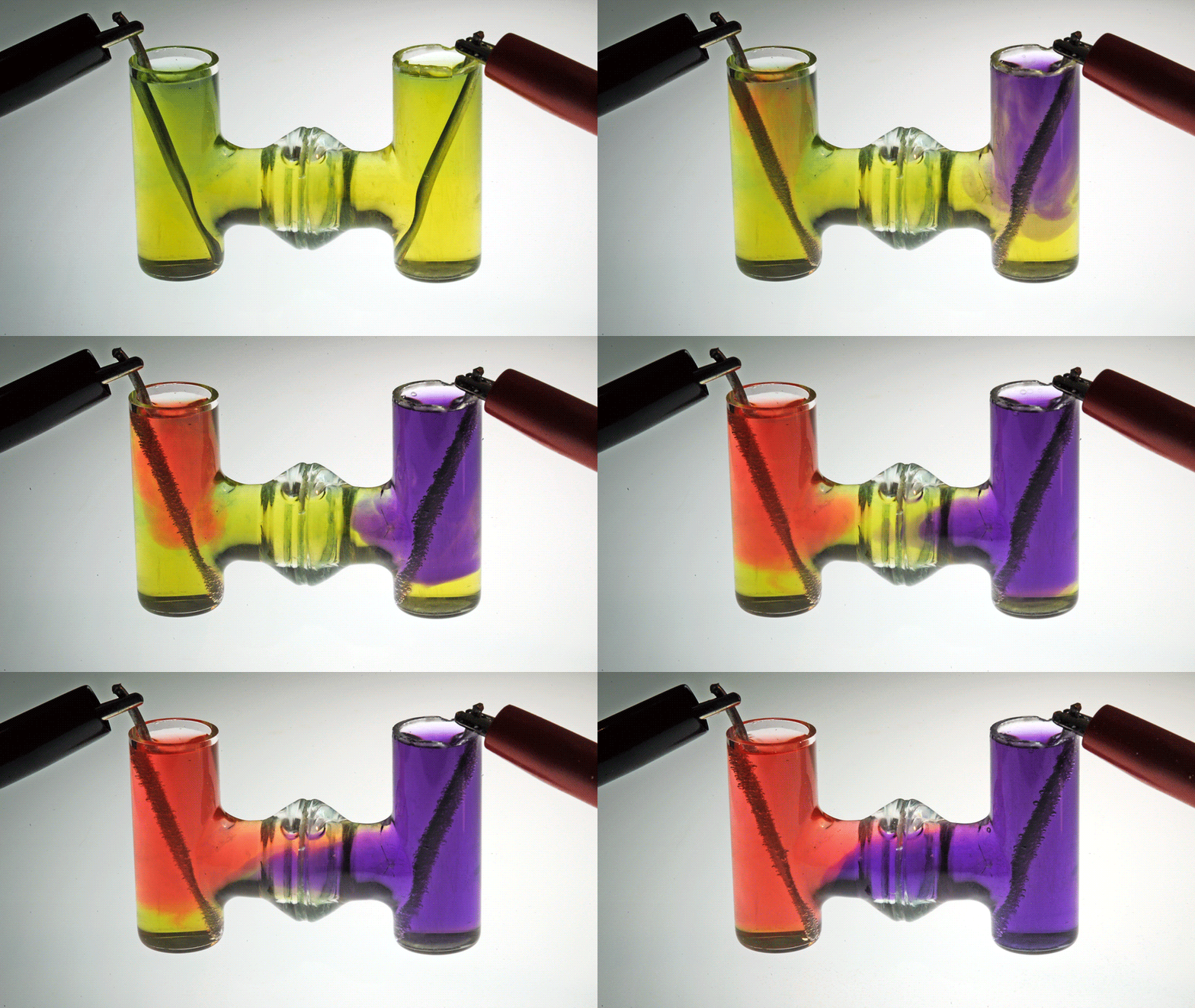 A pathway to zero carbon cement: Review, Ellis et al: Toward electrochemical synthesis of cement
 -
ASR Video 1
 An over-the-shoulder look at ASR in concrete as seen using the SEM.
 -
Book Review - Alkali-Aggregate Reaction in Concrete: A World Review
 The UC review of "Alkali-Aggregate Reaction in Concrete: A World Review" edited by Iam Sims and Alan Poole.
Almost everyone interested in cement is also concerned to at least some degree with concrete strength. This ebook describes ten cement-related characteristics of concrete that can potentially cause strengths to be lower than expected. Get the ebook FREE when you sign up to CEMBYTES, our Understanding Cement Newsletter - just click on the ebook image above.