Manufacturing - the cement kiln
Most Portland cement is made in a rotary kiln. Basically, this is a long cylinder rotating about its axis once every minute or two. The axis is inclined at a slight angle, the end with the burner being lower.
The rotation causes the raw meal to gradually pass along from where it enters at the cool end, to the hot end where it eventually drops out and cools. They were introduced in the 1890s and became widespread in the early part of the 20th century and were a great improvement on the earlier shaft kilns, giving continuous production and a more uniform product in larger quantities.
For information on reactions in the kiln see the clinker pages.
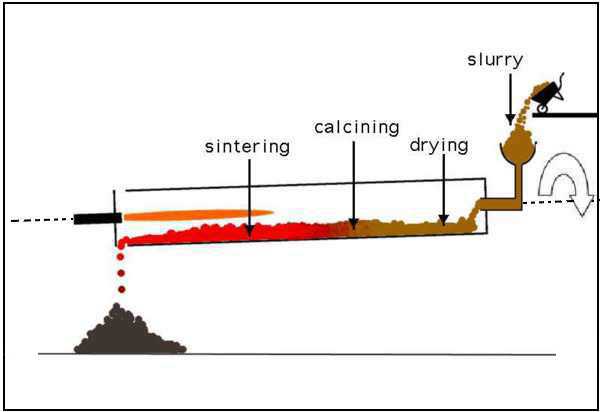 Basic principle of a wet-process kiln.
Wet process kilns
The original rotary cement kilns were called 'wet process' kilns. In their basic form they were relatively simple compared with modern developments. The raw meal was supplied at ambient temperature in the form of a slurry.
A wet process kiln may be up to 200m long and 6m in diameter. It has to be long because a lot of water has to be evaporated and the process of heat transfer is not very efficient.
The slurry may contain about 40% water. This takes a lot of energy to evaporate and various developments of the wet process were aimed at reducing the water content of the raw meal. An example of this is the 'filter press' (imagine a musical accordion 10-20 metres long and several metres across) - such adaptions were described as 'semi-wet' processes.
The wet process has survived for over a century because many raw materials are suited to blending as a slurry. Also, for many years, it was technically difficult to get dry powders to blend adequately.
Quite a few wet process kilns are still in operation, usually now with higher-tech bits bolted on. However, new cement kilns are of the 'dry process' type.
Dry process kilns
In a modern works, the blended raw material enters the kiln via the pre-heater tower. Here, hot gases from the kiln, and probably the cooled clinker at the far end of the kiln, are used to heat the raw meal. As a result, the raw meal is already hot before it enters the kiln.
The dry process is much more thermally efficient than the wet process.
Firstly, and most obviously, this is because the meal is a dry powder and there is little or no water that has to be evaporated.
Secondly, and less obviously, the process of transferring heat is much more efficient in a dry process kiln.
An integral part of the process is a heat exchanger called a 'suspension preheater'. This is a tower with a series of cyclones in which fast-moving hot gases keep the meal powder suspended in air. All the time, the meal gets hotter and the gas gets cooler until the meal is at almost the same temperature as the gas.
The basic dry process system consists of the kiln and a suspension preheater. The raw materials, limestone and shale for example, are ground finely and blended to produce the raw meal. The raw meal is fed in at the top of the preheater tower and passes through the series of cyclones in the tower. Hot gas from the kiln and, often, hot air from the clinker cooler are blown through the cyclones. Heat is transferred efficiently from the hot gases to the raw meal.
The heating process is efficient because the meal particles have a very high surface area in relation to their size and because of the large difference in temperature between the hot gas and the cooler meal. Typically, 30%-40% of the meal is decarbonated before entering the kiln.
A development of this process is the 'precalciner' kiln. Most new cement plant is of this type. The principle is similar to that of the dry process preheater system but with the major addition of another burner, or precalciner. With the additional heat, about 85%-95% of the meal is decarbonated before it enters the kiln
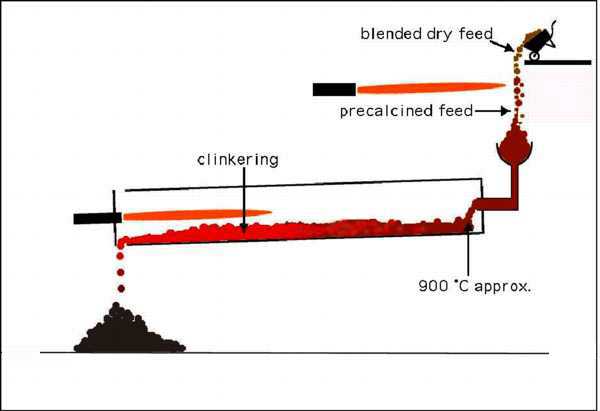 Basic principle of a precalciner cement kiln.
Since meal enters the kiln at about 900 C, (compared with about 20 C in the wet process), the kiln can be shorter and of smaller diameter for the same output. This reduces the capital costs of a new cement plant. A dry process kiln might be only 70m long and 6m wide but produce a similar quantity of clinker (usually measured in tonnes per day) as a wet process kiln of the same diameter but 200m in length. For the same output, a dry process kiln without a precalciner would be shorter than a wet process kiln but longer than a dry process kiln with a precalciner.
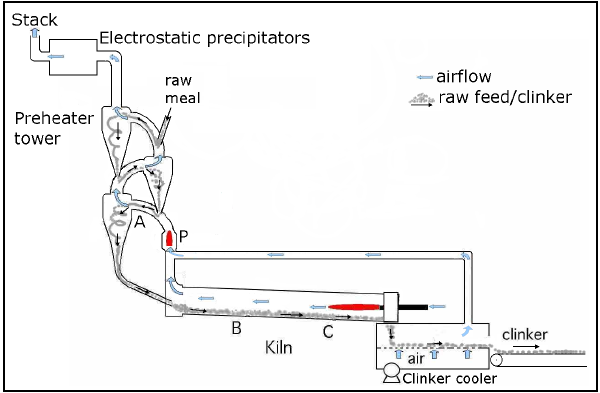 Basic principles of a precalciner cement kiln. See text.
In the diagram above of a precalciner kiln, raw meal passes down the preheater tower while hot gases rise up, heating the raw meal. At 'A,' the raw meal largely decarbonates; at 'B,' the temperature is 1000 C - 1200 C and intermediate compounds are forming and at 'C,' the burning zone, clinker nodules and the final clinker minerals form. A preheater tower is likely to have 4-6 stages, not the three shown here. Many designs are more complex but this diagram illustrates the principle. See the 'Clinker' pages for more information on reactions in the kiln.
The kiln is made of a steel casing lined with refractory bricks. There are many different types of refractory brick and they have to withstand not only the high temperatures in the kiln but reactions with the meal and gases in the kiln, abrasion and mechanical stresses induced by deformation of the kiln shell as it rotates.
Bricks in the burning zone are in a more aggressive environment compared with those at the cooler end of the kiln (the 'back end'), so different parts of the kiln are lined with different types of brick.
Periodically, the brick lining, or part of it, has to be replaced. Refractory life is reduced by severe changes in temperature, such as occur if the kiln has to be stopped. As the cost of refractories is a major expense in operating a cement plant, kiln stoppages are avoided as far as possible.
As the meal passes through the burning zone, it reaches clinkering temperatures of about 1400 C - 1500 C. Nodules form as the burning zone is approached. When the clinker has passed the burning zone, it starts to cool, slowly at first, then much more quickly as it passes over the 'nose ring' at the end of the kiln and drops out into the cooler.
The clinker cooler
There are various types of cooler - we will consider only one, the 'grate cooler'.
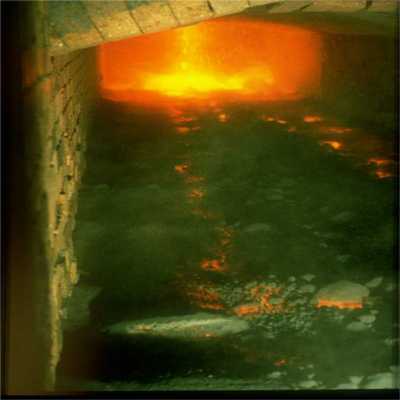 Grate cooler: the hot clinker falls out of the kiln and moves along the cooler, towards the foreground of the image.
The purpose of a cooler is, obviously, to cool the clinker. This is important for a several reasons:
- From an engineering viewpoint, cooling is necessary to prevent damage to clinker handling equipment such as conveyors.
- From both a process and chemical viewpoint, it is beneficial to minimise clinker temperature as it enters the cement mill. The milling process generates heat and excessive mill temperatures are undesirable. It is clearly helpful, therefore, if the clinker is cool as it enters the mill.
- From an environmental and a cost viewpoint, the cooler reduces energy consumption by extracting heat from the clinker, enabling it to be used to heat the raw materials.
- From a cement performance viewpoint, faster cooling of the clinker enhances silicate reactivity.
The cooled clinker is then conveyed either to the clinker store or directly to the clinker mill. The clinker store is usually capable of holding several weeks' supply of clinker, so that deliveries to customers can be maintained when the kiln is not operating.
Get a Better Understanding of Cement
Articles like this one can provide a lot of useful material. However, reading an article or two is perhaps not the best way to get a clear picture of a complex process like cement production. To get a more complete and integrated understanding of how cement is made, do have a look at the Understanding Cement book or ebook. This easy-to-read and concise book also contains much more detail on concrete chemistry and deleterious processes in concrete compared with the website.
Click here for more information
Check the Article Directory for more articles on this or related topics
Recent Articles


-
Zero carbon cement by electrochemical synthesis
 A pathway to zero carbon cement: Review, Ellis et al: Toward electrochemical synthesis of cement
 -
ASR Video 1
 An over-the-shoulder look at ASR in concrete as seen using the SEM.
 -
Book Review - Alkali-Aggregate Reaction in Concrete: A World Review
 The UC review of "Alkali-Aggregate Reaction in Concrete: A World Review" edited by Iam Sims and Alan Poole.
Almost everyone interested in cement is also concerned to at least some degree with concrete strength. This ebook describes ten cement-related characteristics of concrete that can potentially cause strengths to be lower than expected. Get the ebook FREE when you sign up to CEMBYTES, our Understanding Cement Newsletter - just click on the ebook image above.