A few basic chemistry notes
Bemused by chemistry? Read on...
Some very basic chemistry will help a lot with understanding how cement is made and how it works. If you missed out on chemistry at school, or it just seems a long time ago, the following short notes might be useful.
Basic Chemistry 1: Chemical symbols
Chemical symbols are abbreviated forms of the names of chemical elements, eg: Ca (calcium); Si (silicon); K (potassium).
Symbols are usually based on the Latin names, so they don't always resemble the English names especially for elements known in antiquity (eg: Au-gold, aurum).
Some useful elemental symbols in the context of cement follow, with their approximate atomic weights:
| Element |
Symbol |
Atomic weight |
| Hydrogen |
H |
1 |
| Carbon | C |
12 |
| Oxygen |
O |
16 |
| Nitrogen |
N |
18 |
| Sodium |
Na |
23 |
| Magnesium |
Mg |
26 |
| Aluminium |
Al |
27 |
| Silicon |
Si |
28 |
| Phosphorus |
P |
31 |
| Sulfur |
S |
32 |
| Chlorine |
Cl |
35.5 |
| Potassium |
K |
39 |
| Calcium |
Ca |
40 |
| Titanium |
Ti |
48 |
| Chromium |
Cr |
52 |
| Manganese | Mn |
55 |
| Iron | Fe |
56 |
Basic Chemistry 2: Chemical formulae
A chemical formula is more than just a convenient short form of the name of a chemical - they indicate its composition.
For example, common table salt is sodium chloride, NaCl. One molecule of sodium chloride contains one atom of sodium and one of chlorine.
One molecule of calcium carbonate, CaCO3, contains one atom of calcium, one of carbon and three of oxygen.
Basic Chemistry 3: Atomic weights (also known as relative atomic masses)
In the old days, atomic weights were based on hydrogen with an atomic weight of 1. This meant that calcium, with an atomic weight of 40, is 40 times as massive for the same number of atoms as hydrogen.
In other words, if you have 1 gram of hydrogen and 40 grams of calcium, there would be the same number of atoms in each.
These days, atomic weights are not based on hydrogen, but on one-twelfth of carbon-12. There have been other definitions as well, but they are all the same to within about 1%. Although called atomic weights, they are not really weights because they are ratios and therefore dimensionless but the term atomic weight is kept for historical reasons.
The basic point is that the atomic weight tells you the relative masses of atoms. A sodium atom is 23 times as massive as a hydrogen atom and a sulfur atom is twice as massive as an oxygen atom (see the Table above and you'll get the idea).
This is useful because with this knowledge we can calculate how much, by weight, of each element is present in compounds. It also means we can weigh stuff out in the right proportions to make different compounds.
Sodium chloride again: the atomic ratio of sodium to chlorine is 1:1. There is one atom of sodium and one of chlorine. The proportions by weight are different. The weight (relative atomic mass) of sodium is 23 and of chlorine is 35.5. If we add these together we get the formula weight of a sodium chloride molecule: 23+35.5=58.5.
So, the proportion of sodium in sodium chloride is: 23/58.5 x 100% = 39.3% by mass.
The proportion of chlorine in sodium chloride is: 35.5/58.5 x 100% = 60.7% by mass.
Let's do a slightly more complicated one. The formula for calcium carbonate is CaCO3 and from the Table above, the relative atomic mass of calcium is 40, of carbon is 12 and of oxygen is 16.
In calcium carbonate, we have one atom of calcium, one of carbon and three of oxygen. So, the formula weight of calcium carbonate is: 40+12+48=100.
So, calcium carbonate contains 40% calcium, 12% carbon and 48% oxygen by mass.
A little pedantry...
The term 'formula weight' has been replaced by 'molar mass'. Understanding the formula weight is easy, it is just the sum of the atomic weights of all the atoms in the formula for a compound. The molar mass is numerically the same, multiplied by 1 gram/mol. The reason for this is to make the expression dimensionally correct. Atomic weights aren't weights, they are ratios; for calcium carbonate, the molar mass is 100 grams per mol.
'Mol' is the symbol for 'mole' and is linked to the number of atoms in 12 grams of carbon-12, the same as atomic weights. The mole can be applied to elements or compounds.
If that is a bit confusing, look at these illustrative examples to see how moles are used: one mole of calcium weighs 40 grams, one mole of iron weighs 56 grams and one mole of calcium carbonate weighs 100 grams. From these, you should be able to see how moles are used.
For example, try these, using the Table of atomic weights above:
a) How much does 1 mole of potassium weigh?
b) How much do 2 moles of water (H2O) weigh?
c) How many moles are represented by 56g of silicon?
(Answers below)
Basic Chemistry 4: Anions and cations
Atoms are normally electrically neutral because they have the same number of protons (positively charged) as electrons (negatively charged). However, if it gains or loses one or more electrons, an atom becomes electrically charged. For reasons to do with the number of electrons in the outer shell of the atom, some atoms easily gain one or more electrons and others lose one or more electrons.
Those that gain electrons become negatively charged and are called anions. Those that lose an electron become positively charged and are called cations.
If you want more detail, get a book, or go online, and look up valence electrons.
However for now, and to keep it simple, just learn the following:
In normal cement-related compounds, cations and anions have the following charges (valencies):
Hydrogen +1
Carbon +4
Nitrogen +4
Sodium, potassium +1
Calcium, magnesium +2
Aluminium +3
Silicon +4
Phosphorus +5
Oxygen -2
Chlorine -1
Hydroxide (OH) -1
Chromium +3 or +6
Manganese +2 or +3 (can have others)
Iron +2 or +3
Sulfate, sulfur trioxide, (SO3) -2
It may be a bit tedious learning these but it is worth the effort. If you remember the formulae for some compounds as well, you can work out valencies you have forgotten because the charges have to balance.
For example, everyone knows the formula of water is H2O. If you remember hydrogen has a charge of +1 but you forgot about oxygen, water has to be electrically neutral, so the oxygen anion must have a charge of -2.
If you remember that the sodium cation has a charge of +1 and the hydroxide anion -1, you can work out that the formula for sodium hydroxide must be NaOH; it cannot be, for example, Na2OH because it would then be electrically charged by +1.
If you find these basic chemistry short notes useful let us know using the Contact Form and we'll expand them.
If you've found this basic chemistry page useful, why not sign up for our free Newsletter to get updates of new pages on this website and of our publications and other resources for learning about cement?
Answers: a) 39g; b) 36g; c) 2.
Check the Article Directory for more articles on this or related topics


Recent Articles


-
Zero carbon cement by electrochemical synthesis
 A pathway to zero carbon cement: Review, Ellis et al: Toward electrochemical synthesis of cement
 -
ASR Video 1
 An over-the-shoulder look at ASR in concrete as seen using the SEM.
 -
Book Review - Alkali-Aggregate Reaction in Concrete: A World Review
 The UC review of "Alkali-Aggregate Reaction in Concrete: A World Review" edited by Iam Sims and Alan Poole.
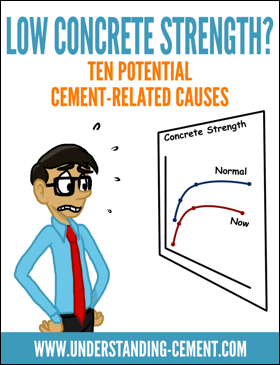
Almost everyone interested in cement is also concerned to at least some degree with concrete strength. This ebook describes ten cement-related characteristics of concrete that can potentially cause strengths to be lower than expected. Get the ebook FREE when you sign up to CEMBYTES, our Understanding Cement Newsletter - just click on the ebook image above.